



Strasbourg Cathedral: digital helps restore beauty
- steve8125
- Jun 17, 2016
- 3 min read
IndPrint
The Strasbourg Cathedral, whose cornerstone was laid in 1015 and completed in 1439, has been standing proud for a thousand years; but since 1683, it was missing a large part of its stained glass artwork. That is until September 2015, when the clear glass panels were refurbished and replaced by stunning, digitally printed glass.
Thanks to the artistry of the designers, artist Véronique Ellena, master glassmaker Pierre Alain Parot, and the expert team at Saint-Gobain Glassolutions, the full glory of the windows has been restored.
Using an advanced Dip-Tech digital ceramic in-glass printer, this novel stained glass installation was able to achieve a convincing historic look that fully blends with the existing façade and original stained glass.

An historic site like Strasbourg Cathedral required artwork that was both contemporary, while at the same time showed a distinct connection to the past. In addition to sheer beauty, it also needed to meet distinct aesthetic and functional requirements.
Artist Véronique Ellena who designed the project, described her goal as conveying ‘the beauty and diversity of the world’ on glass. She photographed everyday people who came to the cathedral to ‘bring their transfigured colours to the light that penetrates through the stained glass in the cathedral. As a photographer, it was a way to draw the light on the stained glass’.
The end result was an image of the face of Christ, inspired by Hans Memling’s painting ‘Christ’s Benediction’. His face is made up of a montage of 150 of the anonymous faces Véronique photographed. In the installation, Christ’s face is on the right panel, and the left panel pays homage to nature.
Véronique, together with Saint-Gobain Glassolutions and Dip-Tech, then converted the graphic images into a ready to print file formatted for printing directly on glass.
Saint-Gobain, owner of three Dip-Tech digital glass printers, introduced the solution of digital ceramic in-glass printing, knowing it would meet the artist’s distinct requirements.
Besides the need for creating colourful detailed images, the artist wanted to ensure longevity for the project. Or as Jean-Francois Outin, interior and design market director at Saint-Gobain described it, ‘a solution that would last, along with the cathedral itself, for at least another 1000 years’.
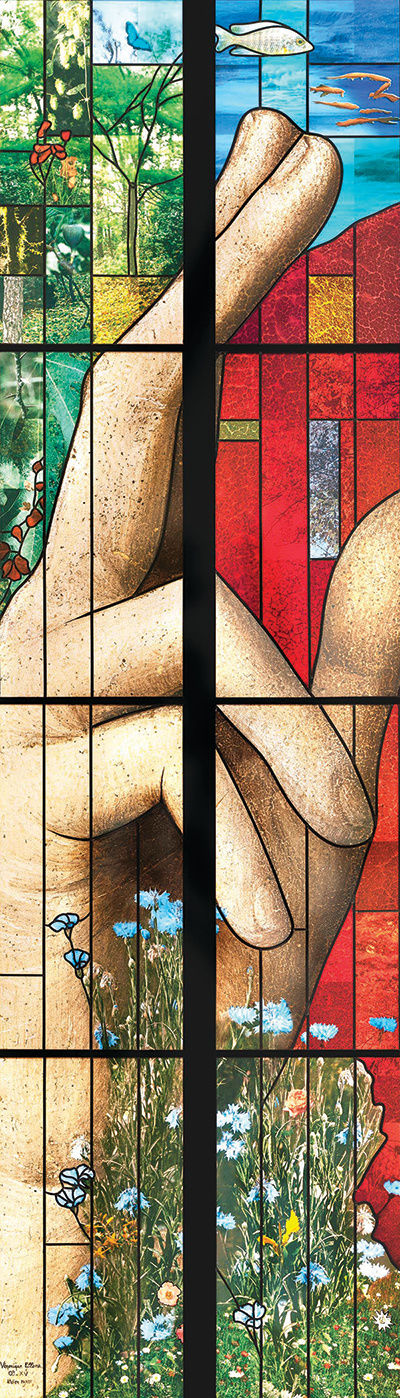
Working together, the industrial process was soon transformed into an artistic process, as the team implemented tests on glass, tweaking the design until the perfect printed results were achieved.
Master glassmaker Pierre-Alain Parot, who was the technical advisor to Véronique from the beginning of the project, was enlisted to put the final touches on the glass. He created a blown glass second skin that was applied over the printed imagery. The stained glass further enhanced the image and feel, creating the perfect blend with the existing Gothic artwork. The final result is a 7.8 metre (25.6 feet) high photomontage consisting of 40 printed panels.
While this was Pierre-Alain’s first time working with digitally printed glass, he was impressed by its functionality. ‘The ability to reproduce photos on the glass with a sustainable technology allows the traditional stained glass painter to enter a new era,’ he said.
‘Strasbourg Cathedral was an historic opportunity, to highlight what digital ceramic in-glass printing can do,’ commented Dip-Tech CEO Alon Lumbroso. ‘We are impressed by what our partner Saint-Gobain was able to achieve – successfully bridging the artwork from millennium to millennium – and we look forward to continuing to develop our technology to match evolving market needs.’


Comments